AI Won’t Replace Leaders. It Will Reveal Them.
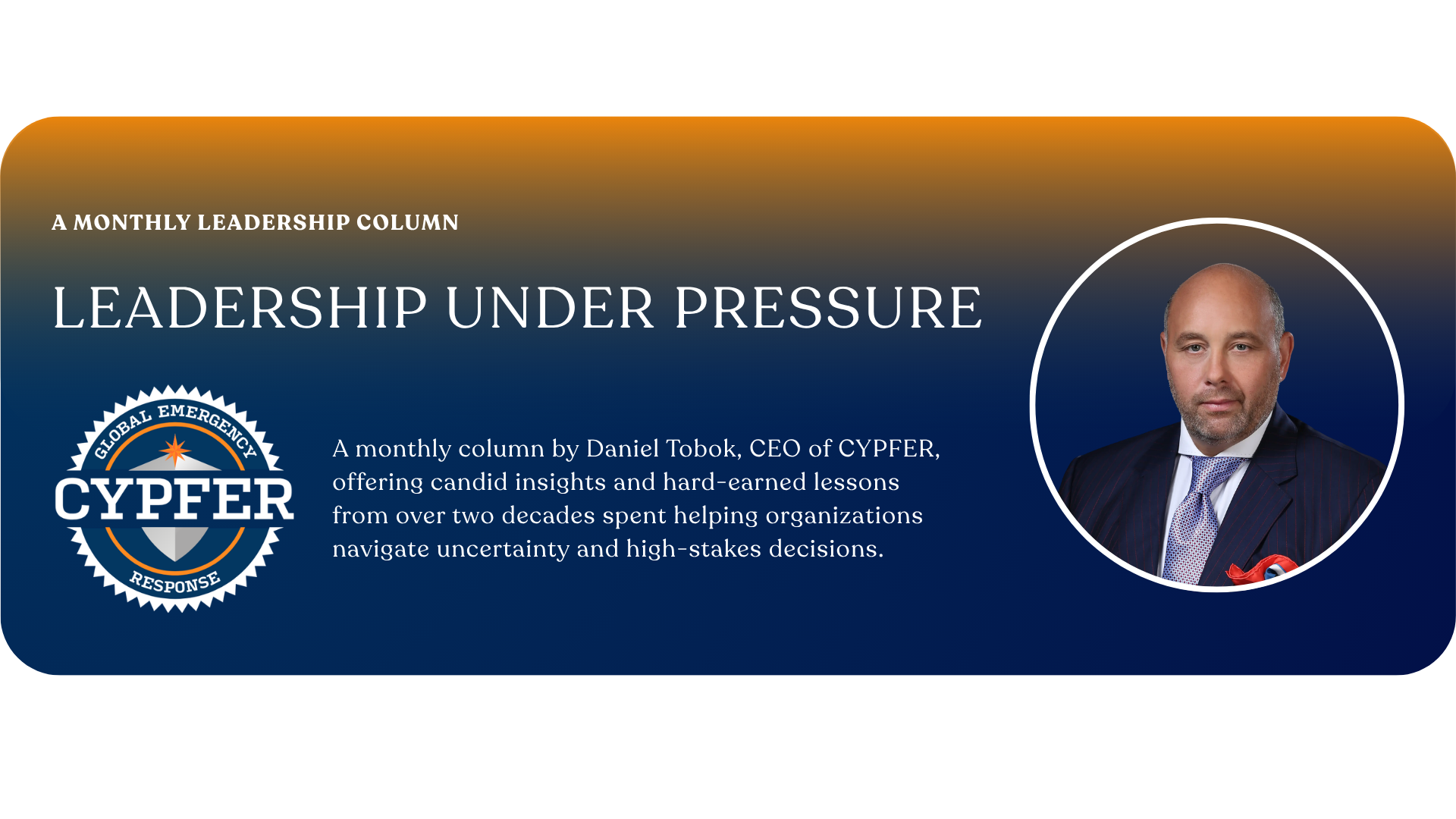
By Daniel Tobok, Founder & CEO, CYPFER

Every few years, a new technology arrives that promises to fundamentally change the way we work.
Over the course of my career, I’ve watched organizations embrace the internet, cloud computing, mobile technology and digital transformation, each one bringing new opportunities, new risks and a new set of predictions about the future of business. Artificial intelligence is no different, although the pace of change is unlike anything we’ve experienced before.
A few years ago, I was sitting in a boardroom with the executive team of an organization that had just experienced a significant cyberattack. Technical experts were working around the clock, outside advisors had joined the call, dashboards filled every screen in the room and there was no shortage of information. In fact, there was almost too much of it. Every specialist had a recommendation, every report pointed in a slightly different direction and every passing hour introduced another variable into the equation.
After several hours of discussion, the CEO leaned back in his chair, looked around the room and asked a simple question.
“So, what do we do now?”
It remains one of the most powerful leadership moments I’ve witnessed because, despite all the technology, expertise and data available in that room, the answer couldn’t be found on a dashboard. It wasn’t hidden inside an algorithm, nor was it waiting to be generated by artificial intelligence. The decision required judgment, experience, accountability and the willingness to accept responsibility for whatever came next.
After more than twenty years helping organizations navigate ransomware attacks, cyber extortion, nation-state activity and some of the most complex cyber incidents around the world, I’ve come to appreciate that technology rarely defines the outcome of a crisis. Leadership does.
That is why I believe we’re asking the wrong question about artificial intelligence.
The conversation has largely centered on whether AI will replace jobs, automate decision-making or fundamentally change how businesses operate. Those are important discussions, but they’re not the ones that interest me most. The more important question is how artificial intelligence will redefine leadership, because while technology continues to evolve at an extraordinary pace, the qualities that define exceptional leaders remain remarkably consistent.
In cybersecurity, we’re already seeing both sides of AI’s potential. Organizations are using artificial intelligence to detect threats faster, identify patterns that humans might miss and reduce the time it takes to respond to incidents. At the very same time, cybercriminals are using those exact capabilities to write more convincing phishing emails, automate malware development and scale attacks in ways that would have been unimaginable only a few years ago.
Technology, as it always has been, is neutral. Its value has never been determined by the tool itself, but by the people making decisions about how it should be used.
The same principle applies inside every boardroom.
One of the biggest misconceptions surrounding artificial intelligence is that having access to more information naturally leads to better decisions. My experience has taught me the opposite. Most executives don’t struggle because they lack information. They struggle because they have too much of it. Reports, dashboards, forecasts, expert opinions and competing priorities all compete for attention, and artificial intelligence will only accelerate that reality.
The challenge has never been finding information. The challenge has always been knowing which information actually matters. I’ve sat beside CEOs who were less concerned about the technical details of an attack than they were about how they would communicate with employees the following morning. I’ve watched boards debate whether transparency would strengthen trust or create unnecessary concern. I’ve seen leadership teams wrestle with decisions where there simply wasn’t a perfect answer, only the responsibility to choose the best path forward with the information available.
Those conversations had very little to do with technology. They had everything to do with leadership. Artificial intelligence can summarize thousands of pages in seconds, identify anomalies across millions of data points and generate recommendations almost instantly, but recommendations are not decisions, predictions are not accountability and intelligence is not judgment.
Judgment is developed through experience, strengthened by perspective and refined by making difficult decisions over many years. It comes from understanding that every business decision affects employees, customers, partners and communities, not simply quarterly results. It requires leaders to ask questions that no algorithm can answer, including whether the right decision is also the ethical one, whether speed should take precedence over certainty and whether protecting trust today is more valuable than protecting short-term performance.
Perhaps that’s why I’m optimistic about the future of leadership. As artificial intelligence becomes more powerful, the qualities that distinguish exceptional leaders become even more valuable. Trust cannot be automated, integrity cannot be programmed and accountability cannot be delegated to software. Those responsibilities remain firmly in the hands of people, regardless of how sophisticated the technology becomes.
History has shown us that every major technological advancement changes the way organizations operate, but it also raises the standard for leadership. Artificial intelligence will undoubtedly make businesses faster, more efficient and, in many cases, significantly smarter, yet it will also demand leaders who are capable of thinking critically, communicating honestly and exercising sound judgment when the right answer isn’t immediately obvious.
Over the past twenty years, I’ve learned that organizations rarely remember the technology that helped them through their most difficult moments. What they remember are the leaders who remained calm, communicated with honesty, inspired confidence and accepted responsibility when everyone else was looking for certainty.
Artificial intelligence will continue to reshape industries for years to come, and I have no doubt it will become one of the most transformative technologies of our generation. What it won’t change is the fundamental responsibility of leadership, because no matter how intelligent our systems become, people will always look to other people for direction, confidence and trust when the stakes are highest.
The future won’t belong to the organizations with the most artificial intelligence. It will belong to the organizations led by people who understand that technology can accelerate decisions, but only leadership gives those decisions meaning.
About Daniel Tobok
Daniel Tobok is the Founder and CEO of CYPFER, a global cybersecurity and recovery-led incident response firm. For more than twenty years, he has advised boards, executive teams, insurers, law firms and government agencies through ransomware attacks, cyber extortion and some of the world’s most complex cyber incidents. His experience helping leaders navigate uncertainty has shaped his perspective on resilience, executive decision-making and the human side of cybersecurity.
Continue the Conversation
Artificial intelligence is changing every industry, but the most important conversations are no longer about technology alone. They are about leadership, judgment and how organizations build trust in an increasingly complex world.
Each month, I’ll share perspectives drawn from more than two decades helping leaders navigate cyber crises, executive decision-making and organizational resilience.
If these topics resonate with you, I invite you to follow the series and connect with me on LinkedIn as we continue exploring what it means to lead with confidence in an era of constant change.

Your Complete Cyber Security Partner:
Every Step, Every Threat.



At CYPFER, we don’t just protect your business—we become part of it.
As an extension of your team, our sole focus is on cyber security, ensuring your peace of mind. From incident response and ransomware recovery to digital forensics and cyber risk, we integrate seamlessly with your operations. We’re with you 24×7, ready to tackle threats head-on and prevent future ones.
Choose CYPFER, and experience unmatched dedication and expertise. Trust us to keep your business secure and resilient at every turn.

Get Cyber Certainty™ Today
We’re here to keep the heartbeat of your business running, safe from the threat of cyber attacks. Wherever and whatever your circumstances.
Contact CYPFER